What is GST?
Goods and Services Tax (GST) is an indirect tax introduced in India to replace multiple indirect taxes such as VAT, Service Tax, Excise Duty, etc.
GST follows the concept of:
One Nation, One Tax
GST is levied at the point of supply and is categorized as:
- CGST – Central Goods and Services Tax
- SGST – State Goods and Services Tax
- IGST – Integrated Goods and Services Tax
- UTGST – Union Territory GST
GST is destination-based and collected by both Central and State Governments.
Who Needs GST Registration? (2026 Updated Limits)
Turnover-Based Registration
GST Registration is mandatory if aggregate turnover exceeds:
- ₹40 Lakhs – For supply of goods (normal category states)
- ₹20 Lakhs – For supply of services
- ₹20 Lakhs – For goods in special category states
Special category states threshold: ₹20 Lakhs (goods) and ₹10 Lakhs (services)
Note: Exempt supply businesses are not required to register unless falling under mandatory categories.
Mandatory Registration (Regardless of Turnover)
GST Registration is compulsory for:
- Inter-state supply of goods
- E-commerce sellers
- E-commerce operators
- Casual taxable persons
- Non-resident taxable persons
- Reverse charge taxpayers
- Input Service Distributor (ISD)
- Persons liable under TDS/TCS under GST
- Agents of suppliers
- OIDAR service providers from outside India
Operating without GST registration (when required) attracts heavy penalties.
Types of GST in India
CGST
Levied by Central Government on intra-state supply.
SGST
Levied by State Government on intra-state supply.
IGST
Levied on inter-state supply and imports.
UTGST
Applicable in Union Territories without legislature.
GST Slab Structure (2026)
GST is structured into 5 slabs:
- 0% – Essential goods
- 5% – Mass consumption items
- 12% – Standard rate
- 18% – Standard rate (most goods/services)
- 28% – Luxury/sin goods
Some goods attract compensation cess in addition.
Composition Scheme (2026 Update)
Eligibility:
- Turnover up to ₹1.5 Crore (₹75 Lakhs for special category states)
- Service providers (under Section 10(2A)) – up to ₹50 Lakhs
Tax Rates:
- Manufacturers & Traders – 1%
- Restaurants – 5%
- Service Providers – 6%
Key Points:
- Cannot collect GST from customers
- Cannot claim Input Tax Credit
- Quarterly tax payment
- Annual return filing
Not eligible:
- Inter-state suppliers
- E-commerce sellers
- Manufacturers of notified goods
Benefits of GST Registration
- Legal recognition as supplier
- Ability to collect GST
- Input Tax Credit eligibility
- Expansion through e-commerce platforms
- Higher business credibility
- Avoid penalties and legal risks
- Simplified unified tax structure
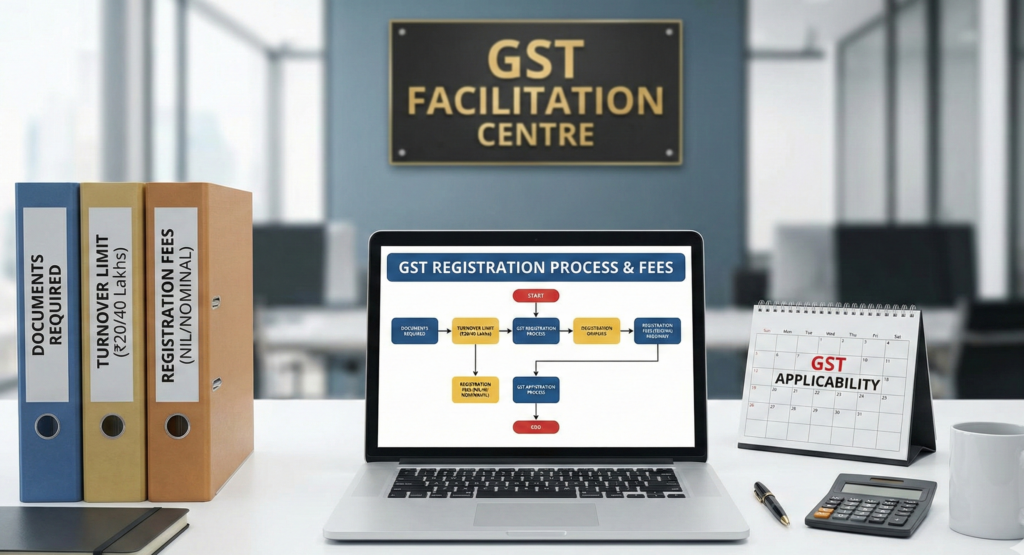
GST Registration Process
Step 1: Visit GST Portal (www.gst.gov.in)
Step 2: Generate Temporary Reference Number (TRN)
Step 3: Fill Part-B of GST REG-01
Step 4: Upload required documents
Step 5: Aadhaar Authentication
Step 6: ARN generated
Step 7: GSTIN issued within 7 working days (if no clarification required)
GSTIN is a 15-digit unique identification number.
Documents Required for GST Registration (2026)
For Proprietorship:
- PAN Card of proprietor
- Aadhaar Card
- Bank statement
- Address proof of business
- Passport-size photograph
For Partnership / LLP:
- PAN of firm
- Partnership deed
- PAN & Aadhaar of partners
- Address proof
- Bank details
For Company:
- PAN of company
- Certificate of Incorporation
- MOA & AOA
- PAN & Aadhaar of directors
- Board resolution
- Registered office proof
- Bank details
Utility bill should not be older than 2 months.
Multiple GST Registration
- One GST registration per state per PAN.
- Separate registration required for each state of operation.
- Separate registration may be obtained for distinct business verticals (optional).
GST Registration Fees
Government Fee: NIL
Professional charges vary depending on service quality and complexity.
Frequently Asked Questions
Can I apply for GST Registration online?
Yes. Entire process is online via GST portal.
Is GST threshold same for all states?
No. Special category states have lower threshold.
Is GST applicable to freelancers and bloggers?
Yes, if turnover exceeds threshold or inter-state supply involved.
Is GST compulsory for inter-state supply?
Yes, generally mandatory regardless of turnover.
For professional assistance in GST Registration and compliance, consult experienced tax professionals to ensure smooth registration and regulatory adherence.