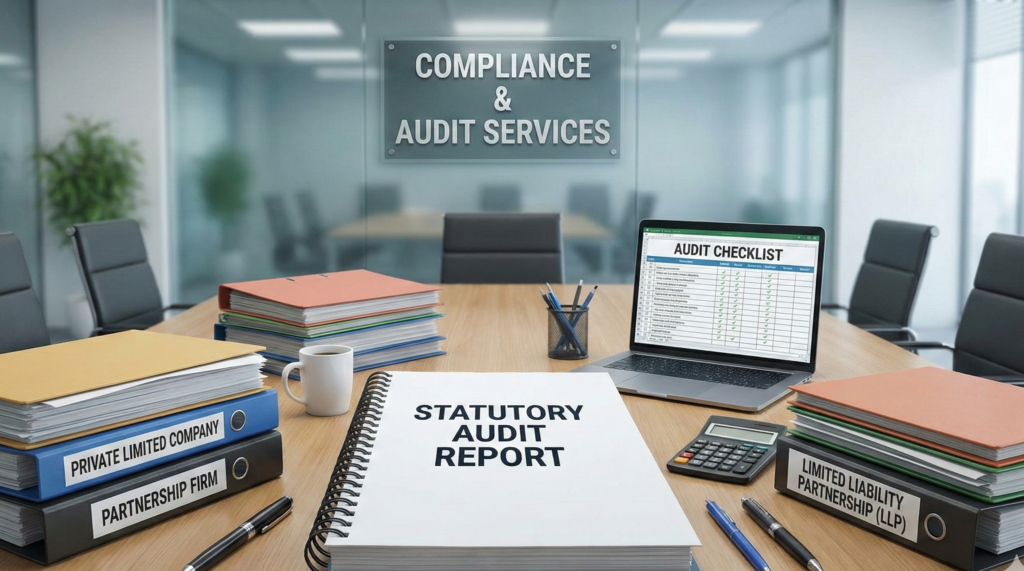
What is a Statutory Audit?
A Statutory Audit is a legally mandated examination of a company’s or LLP’s financial statements and records to ensure accuracy, transparency, and compliance with applicable laws.
For companies, statutory audit is governed by the Companies Act, 2013 and Companies (Audit and Auditors) Rules, 2014.
For LLPs, audit applicability is governed under the LLP Act, 2008 and LLP Rules.
The purpose of statutory audit is to provide an independent opinion on whether the financial statements present a true and fair view of the financial position and performance of the entity.
Applicability of Statutory Audit (2026)
For Companies (Private / Public / OPC)
Statutory audit is mandatory irrespective of turnover, profit, or business activity.
Even if the company is incurring losses, audit is compulsory every financial year.
For LLP
Statutory audit is required if:
- Annual turnover exceeds ₹40 Lakhs, OR
- Contribution exceeds ₹25 Lakhs
If both limits are below threshold, audit is not mandatory (unless voluntarily opted).
For Partnership Firms
Audit is mandatory under Income Tax Act if turnover exceeds:
- ₹1 crore (business)
- ₹50 lakhs (profession)
Subject to Section 44AB and applicable amendments.
Audit of Internal Controls
Auditors evaluate internal financial controls to assess risk of material misstatement. This includes review of authorization processes, segregation of duties, documentation practices, and accounting procedures.
Based on control effectiveness, auditors determine the extent of substantive testing required.
Key Areas Covered in Statutory Audit
Balance Sheet Verification
- Share capital and related resolutions
- Secured and unsecured loans
- Fixed assets and depreciation
- Inventory valuation
- Investments and deposits
- Trade receivables and payables
- Statutory dues and provisions
Profit & Loss Account Review
- Revenue recognition
- Expense verification
- Margin analysis
- Year-on-year comparison
- Compliance with Accounting Standards
GST Reconciliation (Where Applicable)
Though GST audit under GST law is no longer mandatory, reconciliation between books and GST returns (GSTR-1, GSTR-3B, GSTR-2B) is reviewed during statutory audit.
TDS Compliance Review
Auditors verify:
- Applicability of TDS on payments
- Timely deduction and deposit
- TDS return filing
- Reconciliation with Form 26AS
- Compliance with Sections 194, 192, etc.
Non-compliance is reported in audit observations.
Additional Statutory Checks
During statutory audit, auditors may review:
- Compliance with Section 185 & 186 (Loans & Investments)
- Cash transaction limits under Section 269ST
- Section 40A(3) cash payment restrictions
- Provident Fund, ESIC, Gratuity compliance
- Dividend declarations (if applicable)
- Related party transactions
CARO Reporting (For Applicable Companies)
Certain companies are required to comply with Companies (Auditor’s Report) Order (CARO) 2020. CARO requires additional reporting on loans, inventory, statutory dues, fraud reporting, and internal controls.
Applicability depends on company size and classification.
Statutory Audit Timeline
- Appointment of auditor within 30 days of incorporation
- Audit completion before Board approval of financial statements
- Filing of AOC-4 within 30 days of AGM
For professional assistance with statutory audit and compliance under the Companies Act and LLP Act, consult experienced audit professionals to ensure accurate financial reporting and regulatory adherence.